How to Make a Pre-War Apartment Feel Modern—Without Losing Its Charm
Every New Yorker who lives in a pre-war apartment knows the feeling: a deep admiration for the original details—and a quiet wish for better storage, updated lighting, and a little more flow. When we began work on a home on West End Avenue, our client felt exactly that. The apartment had incredible bones: high ceilings, intricate moldings, beautifully scaled rooms. But it also needed a more current rhythm—something lighter, more open, more personal.
We didn’t want to erase the past. We wanted to build on it.

Holding Onto the Good Bones
From the start, we knew this apartment didn’t need a dramatic reinvention. It just needed a thoughtful edit. The dining room’s proportions were lovely, with tall walls that practically asked for wallpaper. We chose a moody floral pattern—something romantic and rich, yet grounded—and wrapped the whole room to create a cocoon-like feel.

The custom cabinetry—painted a deep, chalky blue—was designed to feel original to the space, but behind the paneled fronts: wine storage, mirrored backsplashes, and adjustable glass shelves. These are the quiet luxuries that make older homes more livable without calling attention to themselves.
A Conversation Between Eras
We treated the apartment like a conversation between generations: old-world craftsmanship meeting modern ease. That meant mixing textures and time periods—velvet dining chairs with sculptural backs, a carved elegant table, and a chandelier made of stacked clear glass leaves. None of it perfectly matched, but all of it felt right together.
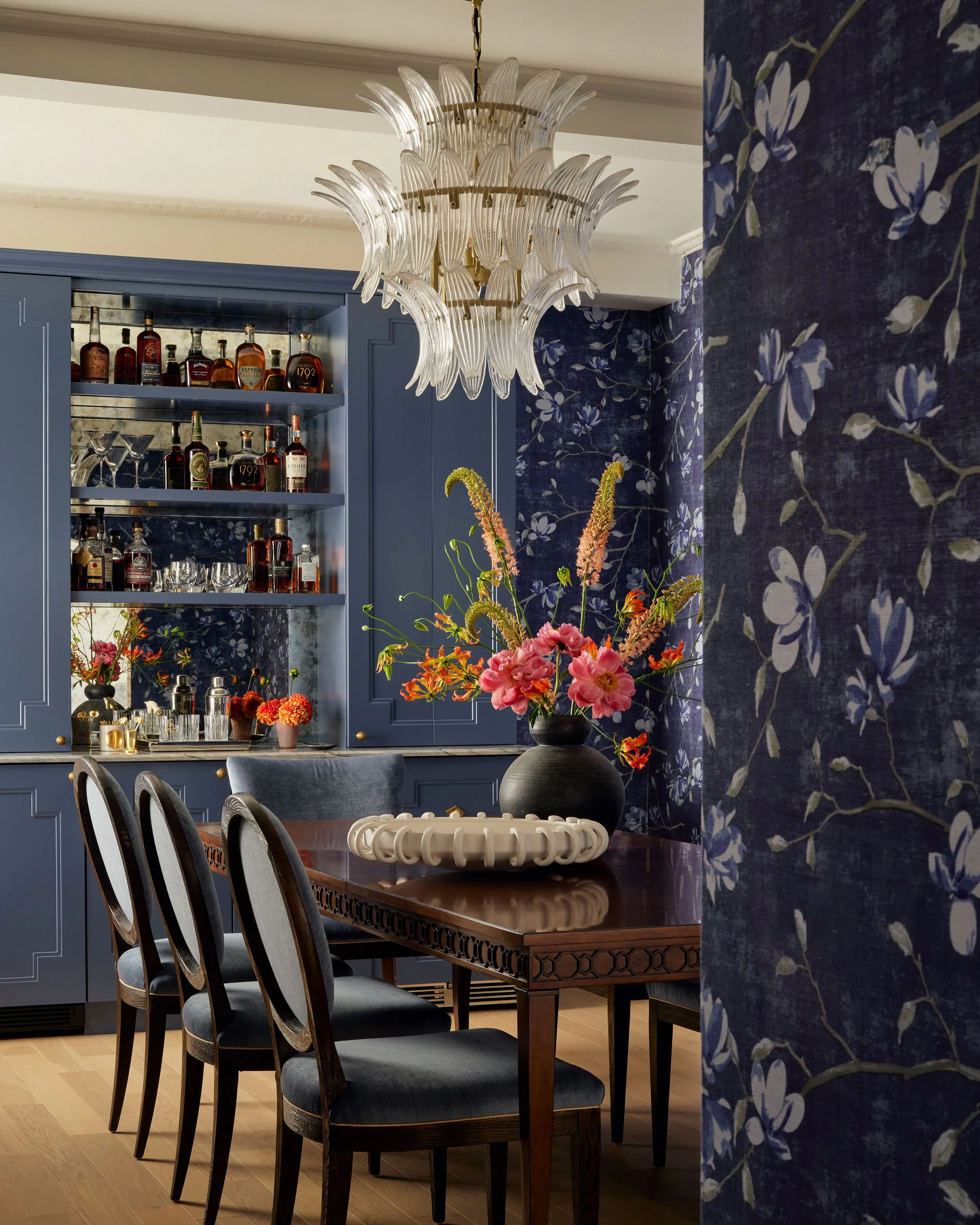
There’s a rhythm to these rooms now. A sense of effortlessness that, ironically, takes a lot of care to create.
Letting Color Lead the Way
The client had a quiet palette in mind at first—but as the project unfolded, a richer color story emerged. Deep blues in the dining room gave way to sunny ochres and unexpected pattern play in the hallway.

The bright yellow print, flanked by a pair of playful velvet ottomans with fringe, became a pivot point—introducing a warmth that carries into the rest of the apartment.
Light, Air and Bit of Whimsy
In the living room, we kept things soft and sculptural. The large coffee table adds a bit of curve to all the architectural lines, and the hand-knotted rug and white linen drapery keep the mood quiet and calm. Pops of color come in through art, a single chair and accessories, rather than the big furnishings themselves.

That’s the thing about pre-war spaces—they don’t need to shout. They just need space to breathe.
The Hidden Challenge: What Lies Behind the Walls
One of the most surprising—and humbling—challenges of renovating a pre-war apartment in NYC is something most people never see: the infrastructure behind the plaster. These buildings were built to last, but they weren’t built for modern life.
Electrical wiring can be brittle and insufficient for today’s lighting loads. Plumbing may be shared vertically between units, meaning a change in your bathroom could affect the neighbor two floors down. And behind those charming thick walls? Sometimes a mix of crumbling horsehair plaster, uneven furring strips, or even structural surprises that no floor plan will reveal.

In the West End Avenue apartment, we discovered that installing a single recessed outlet meant threading wiring through a wall cavity filled with 90-year-old mortar and lathe—an architectural archaeology dig that took a full day for just one line. And then there are the floors: rarely level, often sloping subtly from one end of the room to the other. We’ve learned to design with a slight pitch in mind—adjusting cabinet heights, customizing millwork, even subtly altering furniture legs so that pieces sit gracefully in a space that was never perfectly flat to begin with.
These are the kinds of invisible complications that require patience, adaptability, and a very good contractor. But we believe that working with these limitations—rather than fighting them—is what gives a pre-war home its depth and soul. It’s not about making it perfect. It’s about making it work beautifully, just as it is.
The Heart of the Home is Always a Story
Every apartment tells a story. In this one, we wanted the story to feel layered, grounded, and quietly luxurious—as if the pieces had been collected over time, not ordered all at once. It’s a home that reflects its owner, its history, and the soft evolution that happens when you let design unfold naturally.
If you're lucky enough to live in a pre-war apartment, you already have something rare. The challenge—and the joy—is learning how to bring it forward, without leaving it behind.