Outdoor Kitchen Design Ideas: What to Know Before You Build or Renovate

Minimalist outdoor kitchen design by Libarikian Interiors, AI-generated rendering.
Designing an outdoor kitchen is not the same as extending your indoor kitchen outside. It’s a different environment, a different set of constraints, and—if done well—a completely different experience of living.
There’s a certain expectation around outdoor kitchens—especially in homes where entertaining is part of everyday life. They’re often treated as a checklist: grill, fridge, maybe a pizza oven, and something that resembles an island.
But the outdoor kitchens that truly work—the ones people use constantly, without friction—are rarely the ones with the most features. They’re the ones that have been thought through.
This guide breaks down how we approach outdoor kitchen design for high-end homes, combining practical planning (that prevents costly mistakes) with the level of detail required for a space that feels considered, permanent, and effortless to use. What follows isn’t a list of ideas. It’s how we think about designing outdoor kitchens for clients who expect them to perform as well as they look.
How to Design an Outdoor Kitchen (Why It’s Different from an Indoor Kitchen)
The biggest misconception is that an outdoor kitchen is simply an indoor kitchen relocated outside.
Indoors, everything is controlled: lighting, temperature, surfaces, circulation. Outdoors, none of that is guaranteed. You’re designing within a shifting environment—sun, wind, moisture, uneven grade—and the kitchen has to absorb all of it without becoming difficult to use.
This is why the traditional “work triangle” (sink, stove, refrigerator) often doesn’t apply in the same way. Many outdoor kitchens don’t even include all three elements. And even when they do, people don’t move through the space the way they would inside.
Instead, we think in terms of zones—because that’s how people actually cook and host outdoors.
Outdoor Kitchen Layout Ideas: Why Zones Work Better Than the Kitchen Triangle
A well-designed outdoor kitchen typically resolves into three zones:
A hot zone for cooking (grill, pizza oven, side burners)
A wet zone for cleaning (sink, rinse, basic prep)
A cold zone for storage and preparation (refrigeration, beverage drawers)
The goal isn’t to make it pretty with symmetry, instead it is to optimize the flow. Besides, outdoor kitchens are rarely blessed with enough space to embrace symmetry.
You shouldn’t have to carry something hot across the entire kitchen to find a place to set it down. The grill should always have counter space immediately adjacent to it. The refrigerator should sit near prep—not across the space where guests are walking through.
This is where many outdoor kitchens fail, and we spend quite a bit of time upfront thinking through how our clients will actually cook outdoors, where their guests will gather, and even how they will lay out the food when they entertain.
And almost always, the issue comes back to one thing: lack of landing space.
Outdoor Kitchen Dimensions & Standard Sizes (What Actually Works Outside)
One of the more technical—but critical—differences between indoor and outdoor kitchens is proportion.
Outdoor kitchens require slightly different dimensions, and ignoring them leads to small frustrations that compound over time.
Base cabinets, for example, are typically deeper outdoors—around 30 inches rather than the standard 24. That extra depth isn’t aesthetic. It’s to accommodate grill lids and appliance clearances that don’t exist indoors.
Counter heights often shift slightly higher as well—36 to 38 inches—because you’re accounting for slope underfoot and the fact that people are wearing shoes, moving around, and standing differently than they would inside.
Even something as minor as a corner filler becomes more important outdoors. Appliances are bulkier. Clearances are tighter. These details aren’t visible in photos, but they’re what determine whether the space feels intuitive to use.
Best Outdoor Kitchen Materials: Cabinets, Countertops & Flooring That Last

Outdoor kitchen featuring concrete counters designed by Libarikian Interiors, AI-generated rendering.
Material selection is where outdoor kitchens either hold up beautifully—or begin to degrade almost immediately.
The challenge is that many materials that feel appropriate indoors simply aren’t designed for exposure.
Cabinetry, for example, is typically limited to:
Stainless steel or aluminum (most durable, most predictable)
Polymer-based systems (low maintenance, less refined)
Masonry or stone builds (more architectural, more permanent)
Countertops tend to perform best when they are:
Natural stone (granite, in particular, holds up well)
Porcelain or ultracompact slabs (highly resistant to UV and temperature swings)
Concrete (effective, but requires proper detailing and sealing)
Flooring becomes part of the equation as well—pavers, stone, or concrete slabs tend to outperform anything that behaves like an indoor finish.
What we’re always evaluating is not just how something looks on install day, but how it behaves over time:
Does it fade in direct sun?
Does it absorb heat?
Does it corrode near salt air?
Does it handle freeze–thaw cycles?
The goal is longevity without constant maintenance.
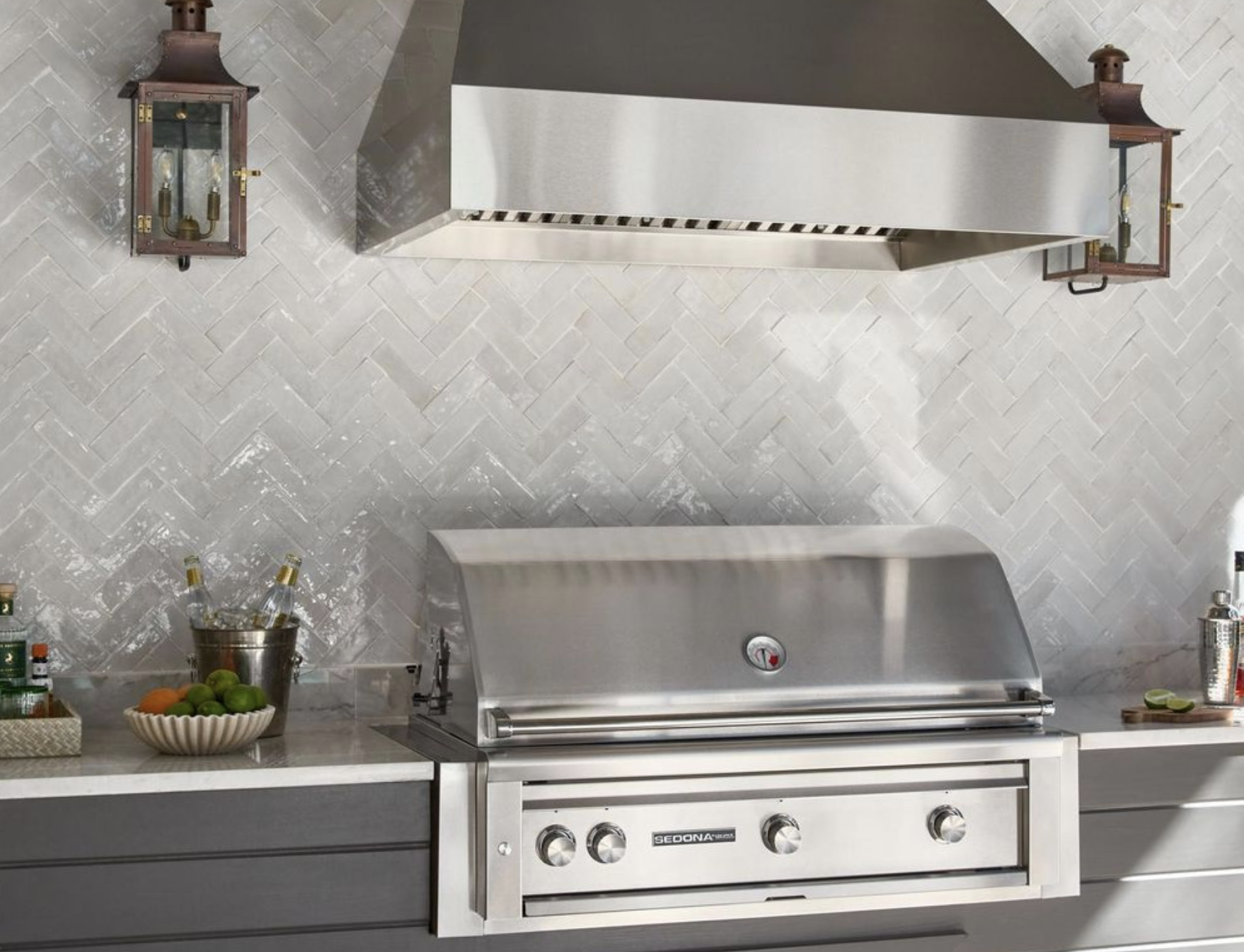
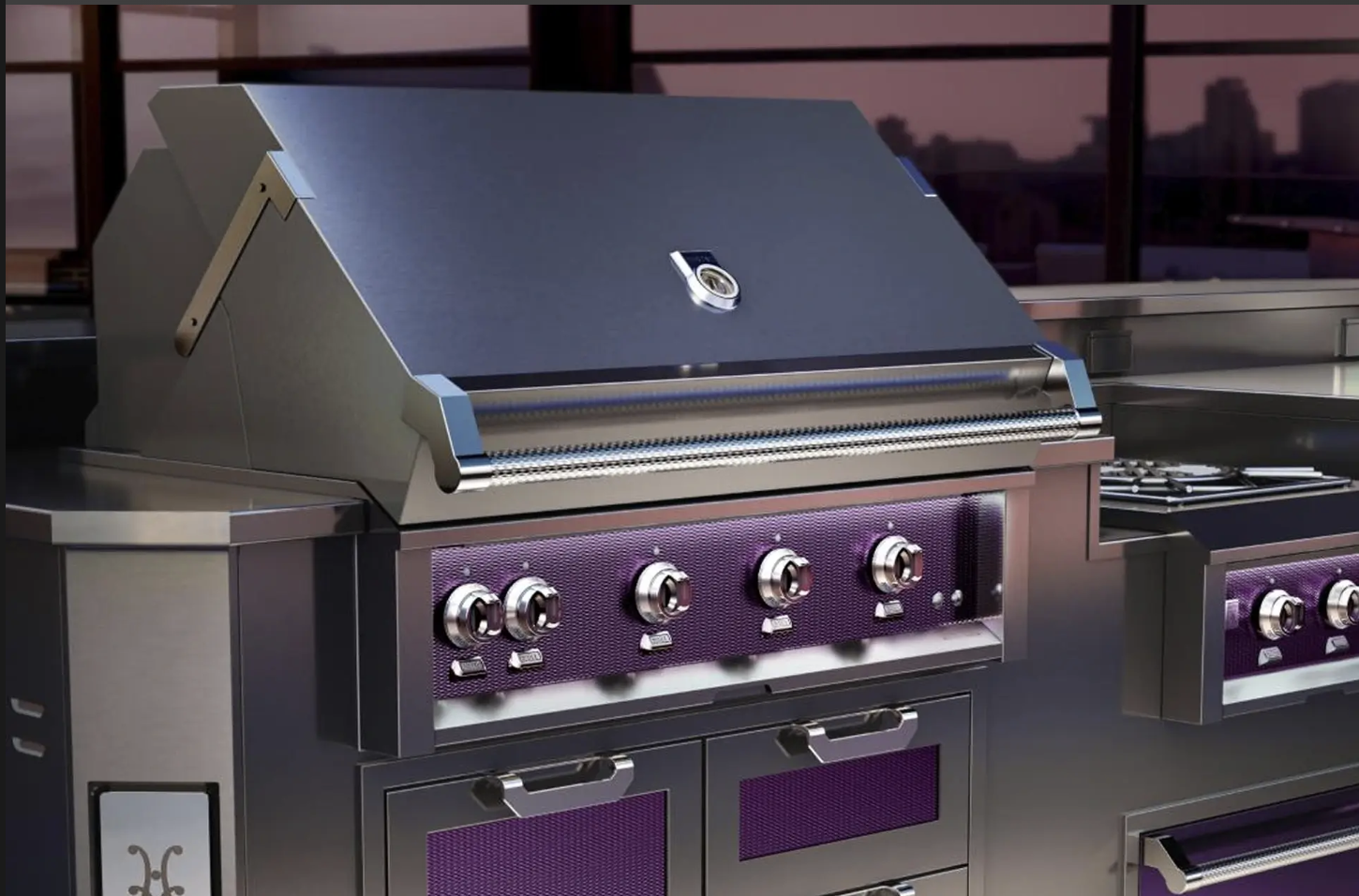
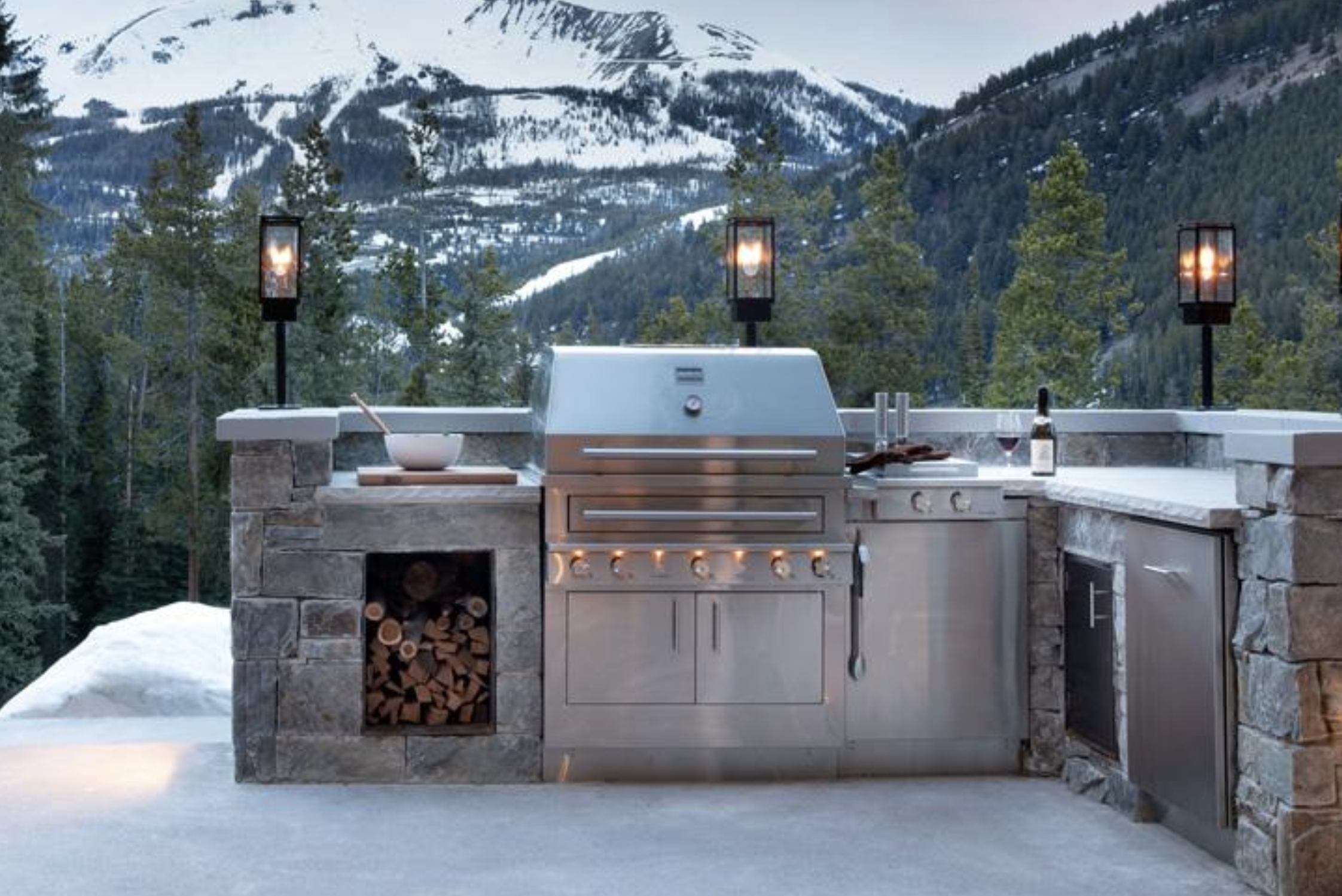
Our Favorite Brands for Outdoor Kitchen Appliances
Outdoor Kitchen Layouts Explained: L-Shaped, U-Shaped, and Island Designs

U-shaped outdoor kitchen design by Libarikian Interiors, AI-generated rendering.
There are familiar layouts—linear, L-shaped, U-shaped, island—but outdoors, the layout is only part of the story.
What matters more is how the kitchen sits within the larger environment.
A linear kitchen can work beautifully if it’s positioned along a wall that frames the space. An island can become the center of the entire outdoor experience—but only if circulation around it is resolved.
Unlike indoors, the kitchen is rarely the dominant feature. It’s part of a sequence:
pool
dining
lounge
landscape
The layout has to respond to that—not compete with it.
Outdoor Kitchen Must-Haves: Sink, Lighting, Electrical & Covered Structures
There are a handful of decisions that tend to be undervalued, but they’re often the ones clients notice most after the fact.
A sink, for example, is easy to omit. But even a simple cold-water sink changes how the kitchen functions—quick rinsing, hand washing, basic prep. Without it, the kitchen becomes dependent on the house.
Lighting is another. It needs to be planned early, not layered in later. Task lighting for cooking, ambient lighting for evenings, and integration into structures or millwork all need to be considered upfront.
Electrical is similar. Outlets are rarely thought about until they’re needed—and by then, they’re difficult to integrate cleanly.
And then there are overhead structures. Pergolas, roofs, and shade elements can define the space—but they have to be carefully coordinated with heat sources and clearances. This is where design and safety intersect.
Outdoor Kitchen Mistakes to Avoid (Design Errors That Cost You Later)
Most outdoor kitchens can easily become overcrowded with appliances that rarely get used. They lack counter space in the places that matter. Lighting is added too late to be integrated properly. Materials are selected for appearance rather than performance.
And perhaps most commonly, they’re designed as if they were indoors. The result is a space that looks complete, but doesn’t quite work. These are the mistakes we see most often (and what to do instead):
1. Skipping Proper Ventilation for Covered Outdoor Kitchens
If your outdoor kitchen sits under a roof, pergola, or enclosed structure, ventilation is not optional.
Built-in grills produce significant heat and smoke
Without proper ventilation hoods, smoke lingers and damages finishes
It also creates a poor cooking experience
What to do instead:
Plan for a vent hood rated for outdoor use and confirm clearances early with your architect and GC.
2. Poor Utility Planning (Gas, Plumbing, Electrical)
Utilities are often treated as an afterthought—but they drive the entire layout.
Gas lines placed too far from appliances
No dedicated electrical circuits for refrigeration or lighting
No plumbing stub-outs for future sink additions
What to do instead:
Finalize your appliance list early and coordinate gas, water, and electrical rough-ins before construction begins.
3. Choosing Indoor-Rated Appliances for Outdoor Use
Not all appliances are built for outdoor exposure.
Indoor refrigerators fail quickly outside
Finishes corrode or discolor
Performance drops in temperature swings
What to do instead:
Use outdoor-rated appliances designed for UV, moisture, and temperature fluctuations.
4. Ignoring Wind Direction and Sun Exposure
This is one of the most overlooked planning factors.
Smoke blowing toward seating or into the house
Harsh afternoon sun making the kitchen unusable
Heat buildup around cooking zones
What to do instead:
Position the kitchen based on prevailing wind patterns and sun orientation—not just available space.
5. Not Planning for Storage (Beyond Cabinets)
Most outdoor kitchens lack usable storage.
No space for grill tools, covers, or serving pieces
Clutter builds up quickly
Items end up stored inside, defeating the purpose
What to do instead:
Include weather-resistant storage sized for how you actually entertain.
6. Overlooking Drainage and Water Management
Water is one of the biggest long-term risks.
Standing water around cabinetry
Improper slope causing pooling
Damage to finishes and structure over time
What to do instead:
Ensure proper grading, drainage, and waterproof detailing are part of the design—not just landscaping.
7. Installing Appliances Without Service Access
Everything will eventually need maintenance.
Built-ins installed too tightly
No access panels for gas or plumbing
Difficult (and expensive) repairs later
What to do instead:
Design for serviceability—leave access points and clearance where needed.
8. Forgetting About Seasonal Use
Outdoor kitchens are used differently across seasons.
No heating elements for shoulder seasons
No covers or protection for winter
Appliances exposed to harsh conditions
What to do instead:
Plan for seasonal flexibility—covers, heaters, or partial enclosure depending on your climate.
9. Not Coordinating Early with Architect + Landscape Design
Outdoor kitchens often get designed in isolation.
Conflicts with hardscaping or grading
Poor alignment with dining or lounge areas
Missed opportunities to integrate with the home
What to do instead:
Coordinate early with your architect, landscape designer, and GC so everything works together.
10. Underestimating Installation Complexity
Outdoor kitchens involve multiple trades.
Masonry, millwork, plumbing, electrical, gas
Lead times for appliances
Sequencing issues during construction
What to do instead:
Treat it like a full construction scope, not a furniture install—plan timeline and trades accordingly.
Outdoor Kitchen Design Process: How We Plan Layout, Materials & Flow

When we design an outdoor kitchen, we’re not starting with appliances—we’re starting with how the space will be used.
How people move through it. Where they gather. What moments it needs to support.
From there, we map zones, resolve circulation, and design the built elements so they feel integrated with the architecture and landscape—not applied afterward.
Material selection is always grounded in longevity. And the detailing—the part that’s hardest to see on paper—is what ensures the space feels effortless once it’s built.
Designing an Outdoor Kitchen for Entertaining: Layout, Flow & Function
Most outdoor kitchens look good when they’re first installed. The real test is how they feel to use a year later.
The ones that hold up—and get used constantly—tend to get a few key things right:
There’s always a place to set things down.
Next to the grill, next to the fridge, near where food is being served. If you’re ever holding a hot tray and looking for space, something was missed.You’re not walking back into the house constantly.
Even a small sink and undercounter refrigerator make a big difference. Without them, the kitchen becomes secondary instead of self-sufficient.It’s comfortable to use at night.
Not just ambient lighting, but actual task lighting over the grill and prep areas. Most outdoor kitchens are under-lit where it matters.The layout accounts for how people gather.
Guests will naturally stand near the cooking area. If there’s no space for them to do that comfortably, the kitchen either feels crowded or disconnected.It still looks good without constant upkeep.
Materials that patina well, don’t overheat in the sun, and don’t require ongoing maintenance tend to age much better than trend-driven selections.
If those pieces are resolved early, the rest tends to fall into place.
Because ultimately, a good outdoor kitchen isn’t about how much you include—it’s about whether it’s easy to use without thinking about it.
What Makes a Luxury Outdoor Kitchen Feel Effortless and Well-Designed
A luxury outdoor kitchen isn’t defined by how much you include—it’s defined by how naturally it fits into your home and how easy it is to use over time.
The ones that feel elevated are usually more restrained. They’re designed around how you actually live, not every possible feature. For some clients, that means a simple, highly functional setup for family use. For others, it’s built to support larger-scale entertaining. The difference is intentionality—knowing what you’ll use, and designing for that.
Equally important is how the kitchen integrates with the architecture. The best outdoor kitchens don’t feel added on—they feel built in. Materials relate to the house, proportions feel considered, and the kitchen sits comfortably within the broader outdoor space rather than competing with it.
Where this really becomes important is in how you plan the investment.
Outdoor kitchens can scale quickly in cost, especially once utilities, appliances, and construction are factored in. The goal isn’t to spend more—it’s to spend in the right places. In most projects, that means prioritizing:
durable, weather-appropriate materials that will age well
thoughtful integration with the home and landscape
quality appliances that match how you’ll actually cook
infrastructure (plumbing, electrical, gas) done correctly from the start
These are the decisions that determine whether the kitchen still feels good to use a few years in—not just the day it’s installed.
When everything is resolved early, the space tends to feel quiet and complete. It works without effort, and it holds up over time.
If you’re planning an outdoor kitchen, we can help you think through those decisions upfront—how it should function, where to invest, and how to make it feel like a natural extension of your home.